Lippincott Review for NCLEX-PN
Skyscape Medpresso IncMedical
4.724.00 Reviews
- Version
- 4.16.0
- Installs
- 10.00K
- Age Rating
- Everyone
Screenshots
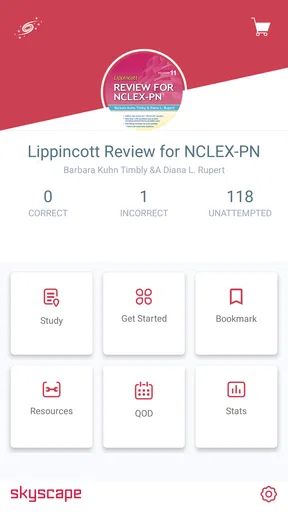
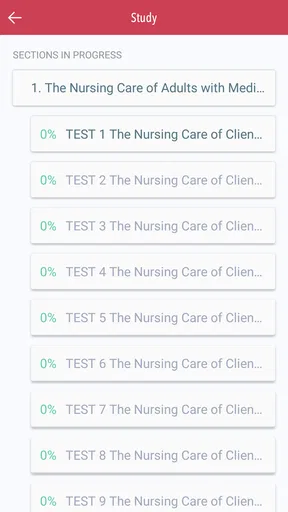
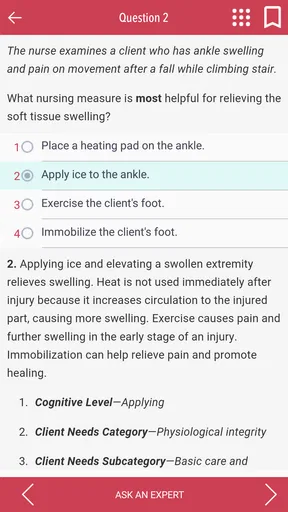
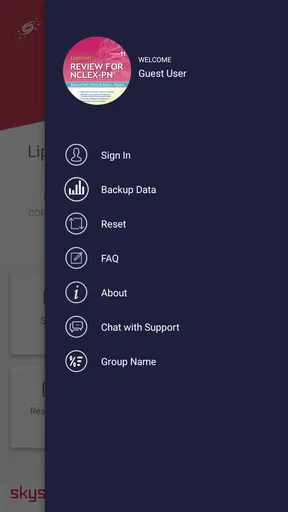
Our Review of Lippincott Review for NCLEX-PN
 Analysis by Appyee
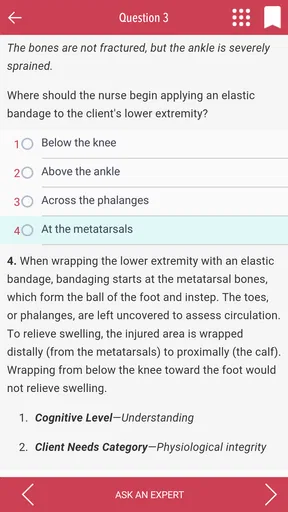
When I want to turn a short study break into useful NCLEX-PN practice, Lippincott Review for NCLEX-PN is the kind of medical app I reach for first. It is built around practice questions rather than long lessons, so the starting point is clear: answer a question, check the rationale, identify the gap, and decide what to review next. That simplicity is its biggest strength, but it also means the app works best as part of a wider study routine rather than as a complete nursing course.
The app comes from Skyscape Medpresso Inc and is listed as a free download for everyone. Its store summary focuses on two thousand questions with rationales, while the short description presents it as a Lippincott review tool. I found that positioning accurate in spirit: this is a question-centered companion for practical revision, not a replacement for class notes, a nursing textbook, or instructor guidance.
Its average rating is 4.7 from 121 ratings, and it has passed 10K+ installs. Those figures suggest a focused audience rather than a massive general-purpose study platform. The app was released on Apr 18, 2018, and the current version is 4.16.0, with Android 5.0 or later required. The download itself is free, although some individual in-app items cost between $22.99 and $44.99. That distinction matters before you build your entire study plan around every available section.
From a weak topic to a repeatable study workflow
I use a weak topic as a cue to change the shape of the next session, not simply to answer more questions on it. I first name the specific decision that keeps tripping me up, then return to practice only after reviewing that principle elsewhere; this helps separate a genuine knowledge gap from a one-off reading mistake. From there, the next step is making that targeted review a repeatable workflow.
Start with a specific problem, not a vague study goal
The most effective way I used this app was not opening it and answering questions randomly for an hour. I began with a narrow target, such as medication safety, prioritization, infection control, or care of a particular patient group. A focused starting condition makes the rationales easier to remember because each answer belongs to a recognizable topic.
If I had just finished a classroom session on fluid and electrolyte balance, I could use a short question session to test whether I understood the clinical decisions behind the lesson. The app then becomes a checkpoint between learning and forgetting. If I missed several questions for the same reason, I knew the problem was not simply bad luck; I needed to return to a textbook or class resource before continuing.
This approach also prevents a common mistake with question banks: treating a high score as proof of readiness. A familiar question can produce a correct answer without genuine understanding. I paid more attention to why an option was right and why the alternatives were less appropriate. That is where the rationales provide their real value.
Answer first, then use the rationale as the handoff
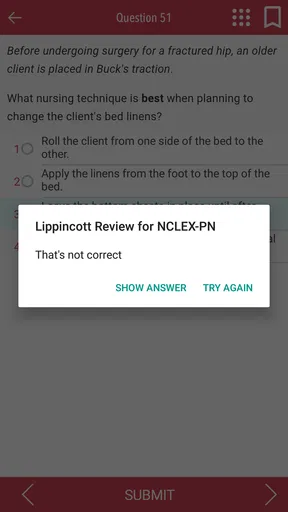
The central workflow is straightforward. I read the question, committed to an answer, and only then examined the explanation. Looking at the rationale before deciding would turn practice into recognition, so I avoided that whenever possible. Even when I felt uncertain, making a choice exposed the exact point where my reasoning broke down.
The rationale is the handoff between testing and teaching. It should not be treated as a paragraph to skim and forget. I used it to ask three practical questions: what clue in the question mattered most, what nursing principle controlled the decision, and what tempting alternative was unsafe or lower priority? Writing a brief note in my own words made the next review session more useful than simply marking the item as correct.
A useful trick is to separate knowledge errors from reading errors. If I knew the clinical principle but missed a word such as “first,” “best,” or “priority,” I recorded that as a test-taking issue. If I could not explain the underlying care decision, I recorded it as a content issue. The app can expose both problems, but the remedy is different: careful reading for one and outside study for the other.
Use short sessions to create a feedback loop
This app suits a fragmented schedule. A commute, lunch break, or quiet period after a clinical shift can become a small review block without requiring a full desk setup. I preferred stopping after a manageable group of questions and reviewing the explanations immediately. That kept the feedback connected to my reasoning instead of allowing several uncertain answers to blur together.
For a realistic everyday routine, I might answer questions after a morning lecture, flag the concepts that caused hesitation, and spend the evening checking those concepts in my nursing notes. The next day, I would return to questions in the same area but avoid memorizing the wording. The desired outcome is not remembering that one option was correct; it is recognizing the patient-safety principle when the situation is described differently.
That workflow also makes the free entry point more practical. A reader can install the app, see whether the question-and-rationale format fits their learning style, and decide later whether paid content is justified. I would not purchase additional material immediately. I would first confirm that I am actually using the existing practice consistently and that the explanations match the level of review I need.
Build handoffs between the app and your main resources
No question bank can carry the entire responsibility for NCLEX-PN preparation. My strongest results came when each session ended with a handoff to another resource. A missed question about a medication, for example, could lead me to review the drug class, expected effects, adverse reactions, and nursing precautions in a trusted reference. A missed prioritization question could lead me back to airway, breathing, circulation, safety, and delegation principles.
The app is therefore best understood as the front end of a study loop. It supplies a decision point and a rationale; my notes, textbook, instructor, or skills material supply depth. If I used only the app, I risked learning isolated answers without building the broad clinical framework needed to handle unfamiliar wording.
I also found it helpful to explain a rationale aloud, as though handing the case to another student. If I could say, “This option comes first because the patient has the most immediate threat to safety,” I had probably understood the decision. If I merely repeated the answer, the handoff had failed and more review was necessary.
Turn results into an action plan
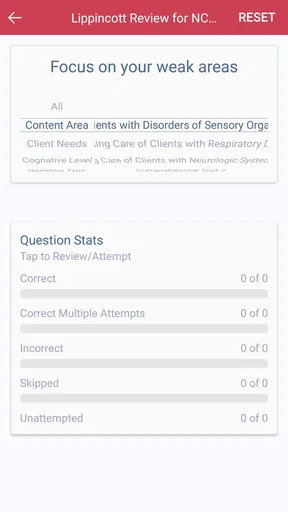
The useful result of a session is not simply a percentage. I looked for patterns across questions: repeated confusion between assessment and intervention, weak recall of precautions, difficulty identifying the unstable patient, or a tendency to choose the most detailed option instead of the safest one. Those patterns tell me what to study next.
For example, if I repeatedly missed questions involving delegation, I would stop doing random practice and review the responsibilities of the practical nurse, the registered nurse, and assistive personnel in the context of the question. If the problem was infection control, I would revisit transmission precautions and apply them to several patient situations. The app starts the diagnosis of the learning problem; I have to complete the treatment.
Another practical technique is to keep a “why I missed it” list. I would record only the concept and the mistake, not copy entire rationales. Later, that list became a compact revision guide built from my own weak points. This is more valuable than collecting a long stack of screenshots because it preserves the reasoning error that needs correction.
Where the workflow becomes less comfortable
The first friction is the difference between a free download and a fully open study library. The app is free to install, but in-app purchases range from $22.99 to $44.99 per item. That does not make the app poor value, but it does mean I would check exactly which content is accessible before treating it as my only preparation tool. A student with a limited budget should compare the available material with school-provided question banks and library resources first.
The second limitation is depth. A rationale can clarify why one answer is preferred, but it may not teach an entire body system from the beginning. Someone who is still learning foundational anatomy, pharmacology, or nursing procedures may feel that the app moves too quickly from question to explanation. In that situation, a structured course or comprehensive textbook is the better starting point, with this app used afterward for retrieval practice.
The third issue is the risk of passive repetition. Answering many questions can feel productive even when the same misunderstanding survives. I had to slow down, explain the reasoning, and connect each missed item to a broader topic. Without that discipline, the app becomes a series of taps rather than meaningful preparation.
There is also a practical device consideration. The minimum operating requirement is Android 5.0, so users on older hardware should check compatibility before planning around it. The app is categorized as medical and carries an Everyone age rating, but that broad rating should not be confused with professional clinical advice. Its purpose is exam preparation, not bedside decision-making or personal medical guidance.
Who should use it, and who should choose something else?
I would recommend it to an NCLEX-PN candidate who already has basic nursing instruction and wants a dedicated question-and-rationale routine. It is especially useful for students who learn by testing themselves, need practice identifying priorities, or have short study windows. The focused format makes it easier to move from “I should study” to a concrete action within a minute.
I would be more cautious recommending it to someone who needs a full curriculum, video demonstrations, extensive care plans, or detailed preparation for clinical skills. Those learners need a broader platform or direct instruction. I would also hesitate if a student tends to memorize answer patterns rather than analyze patient cues; a more guided learning system may provide better structure.
Compared with a printed review book, the app is more convenient for quick sessions and easier to fit into spare moments. A book may be better for sustained reading, annotation, and seeing a topic in a larger context. Compared with a general flashcard app, this tool has a more clinically grounded question-and-rationale workflow, but a flashcard system may be stronger for memorizing compact facts such as terminology or selected medication details. Compared with a full NCLEX preparation platform, it is narrower and potentially less expensive to try, but it may not offer the same breadth of lessons, planning, or adaptive instruction.
My final assessment after following the full loop
What I like most is the clear path from uncertainty to correction: face a nursing question, commit to a decision, read the rationale, identify the reasoning gap, and hand the topic off to a deeper resource. That is a sound study method, and the app keeps the first step uncomplicated. The Lippincott name also gives the product a recognizable review identity without turning the experience into a general medical reference.
What I would not do is rely on it alone. The strongest outcome comes when the questions expose weaknesses and another resource supplies the missing explanation. I would also budget carefully around the in-app purchases and confirm that the available content matches my preparation needs before paying for anything.
Overall, I see Lippincott Review for NCLEX-PN as a practical practice companion rather than a complete exam course. If you already understand the fundamentals and want to sharpen clinical reasoning through repeated questions with explanations, it is worth trying. If you need teaching from the ground up, choose a fuller learning resource first, then use this app to test whether that knowledge holds up when a patient scenario demands a safe, prioritized answer.
Verdict
Strengths of Lippincott Review for NCLEX-PN
- Focused NCLEX-PN content makes study sessions easy to organize.
- Practice questions help reinforce clinical judgment and test-taking skills.
- Explanations clarify why each answer is correct or incorrect.
- Useful for reviewing key nursing topics during short study breaks.
- Can complement classroom instruction and broader NCLEX preparation.
Limitations of Lippincott Review for NCLEX-PN
- The content may feel dense for students seeking a quick, casual review.
- Some learners may need additional resources for detailed topic explanations.
- Practice questions alone cannot replace full-length NCLEX simulations.
- Access may require payment or an active subscription, depending on the edition.
- The interface and available features can vary between app versions.
Other Releases by Skyscape Medpresso Inc
View All
Saunders Comp Review NCLEX PN
Medical4.6

Board Review Series-Pathology
Medical0.0

CURRENT Dx Tx Psychiatry
Medical4.3

Veterinary Advisor: Dogs Cats
Medical4.4
Similar Picks in This Category
View All
WebMD: Symptom Checker
WebMD, LLC4.1

Microphone Amplifier
DOSA Apps4.2

Anatomy Learning - 3D Anatomy
3D Medical OU4.5

Period Tracker and Calendar
SimpleInnovation4.9

GoodRx: Prescription Coupons
GoodRx4.8

CVS Health
CVS Pharmacy4.5
Frequently Asked Questions
What is Lippincott Review for NCLEX-PN, and who is it designed for?
Lippincott Review for NCLEX-PN is a nursing exam preparation app designed primarily for practical and vocational nursing students preparing for the NCLEX-PN licensing examination. It provides practice questions, explanations, and review material intended to reinforce clinical knowledge and test-taking skills. It is most useful for learners who already have basic nursing education and want structured practice before scheduling the exam.
What type of study content and practice questions does the app include?
The app generally focuses on NCLEX-PN-style practice through questions covering major practical nursing subjects, such as fundamentals, pharmacology, medical-surgical nursing, maternal and newborn care, pediatrics, mental health, and care management. Explanations are especially valuable because they help clarify why an answer is correct and why other options are less appropriate. Users should still confirm the current content and question availability in the store listing before downloading.
Can Lippincott Review for NCLEX-PN be used without an internet connection?
Offline access may depend on the app version, the specific resources included, and whether content has been downloaded in advance. Some study features may work without a connection, while account verification, updates, purchases, or synchronized progress can require internet access. Before relying on it during travel or in areas with limited connectivity, open the app offline and check which questions, explanations, and tracking tools remain available.
Is Lippincott Review for NCLEX-PN enough to pass the NCLEX-PN by itself?
The app should be treated as a supplementary preparation tool rather than a complete replacement for nursing school review, official exam information, or a comprehensive study plan. Practice questions can reveal weak areas and improve familiarity with NCLEX-style reasoning, but success also requires reviewing core concepts, understanding clinical priorities, and practicing consistently. Learners should use the app alongside current textbooks, instructor guidance, and official NCLEX resources.
Does the app require payment, a subscription, or an account?
Access conditions can vary by platform, edition, and publisher updates. Some versions may offer free downloading with paid content, while others may require a one-time purchase, subscription, or account login to unlock the full question bank and progress features. Review the Google Play or App Store listing carefully for the current price, in-app purchases, renewal terms, supported devices, and refund policy before completing the download.
